

Starting date: July 2021
Work Programme
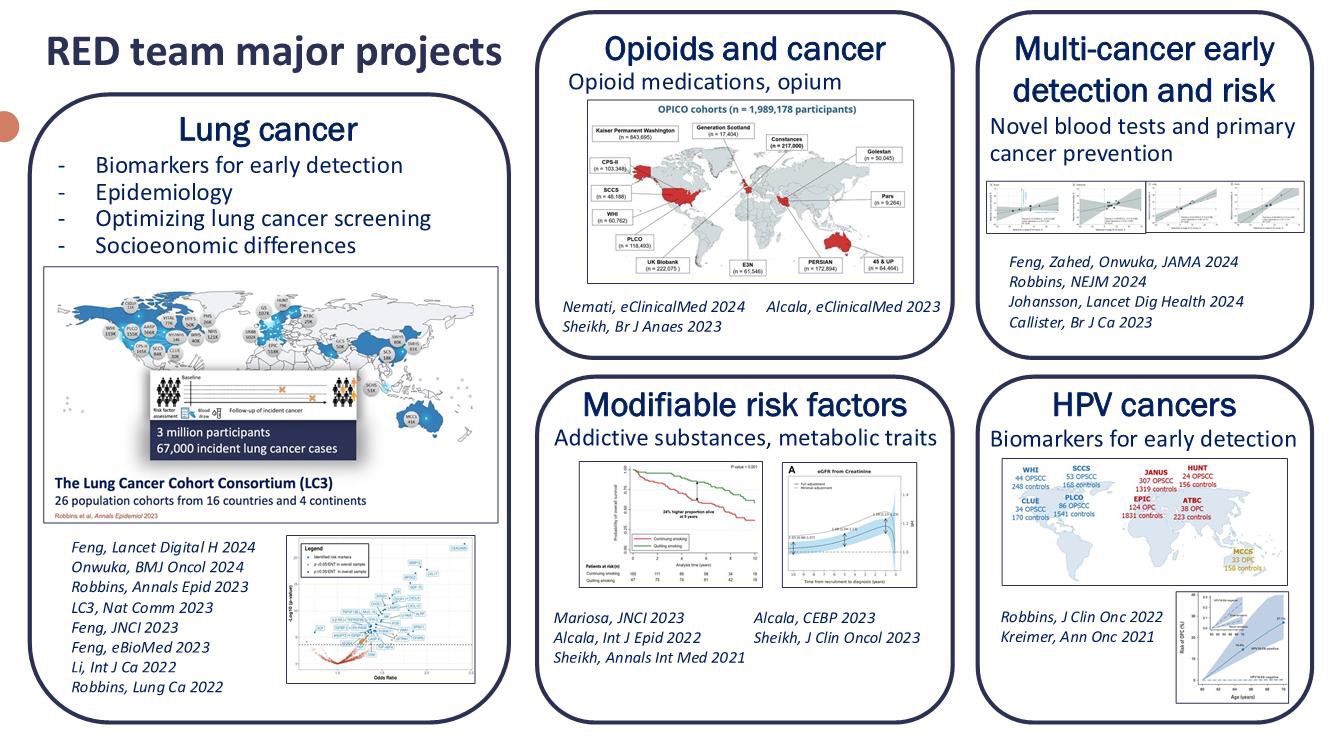
The Risk Assessment and Early Detection Team (RED) conducts translational epidemiological research, bridging discovery and implementation. RED’s ambition is to lead research with strong potential for long-term impact in reducing the burden of cancer.
RED’s vision:
- To inform primary prevention by advancing the understanding of cancer risk and etiology; and
- To inform secondary prevention by optimizing early detection strategies.
RED specializes in organizing large international collaborations to study risk factors, develop risk prediction tools, and identify and evaluate early detection biomarkers. RED leverages the specific strengths of different conceptual, design, and analytical approaches to reach conclusive answers to important research questions, often leveraging the rich data resources generated by consortium studies.
Key objectives:
- Evaluate Emerging Risk Factors
RED assesses the importance of emerging risk factors in cancer etiology among populations in transition, including obesity-related risk factors and addictive substances such as opioids and tobacco exposure. This approach combines complementary observational epidemiological approaches, including direct risk factor measurements in population cohorts and genetically proxied risk factors in large genomic studies. - Advance Early Cancer Detection Using Risk-Based Approaches
RED aims to improve cancer-specific risk assessment by incorporating novel risk indicators – frequently biomarkers – and to develop and validate existing risk prediction tools in diverse populations. A guiding principle is to design studies that mimic the target use population to facilitate implementation studies of risk- and biomarker-based approaches to improve early cancer detection.
RED focuses on several cancer types, with a particular emphasis on lung cancer, kidney cancer, and human papillomavirus (HPV)-associated cancers. All RED projects involve international collaborations, and many include the coordination of large consortia.
Team Composition
Team Leaders: Dr Mattias Johansson and Dr Hilary Robbins, Early Detection, Prevention, and Infections Branch (EPR)
Emails: JohanssonM@iarc.who.int; RobbinsH@iarc.who.int
Team members:
Dr Mahdi Sheikh (Scientist, EPR)
Dr Xiaoshuang Feng (Scientist, EPR)
Dr Shaymaa Alwaheidi (Project Officer, EPR)
Dr Karine Alcala (Senior Research Assistant, Data Management/Analysis, EPR)
Ms Andreea Spanu (Project Assistant, EPR)
Dr Ayaka Teshima (Postdoctoral Scientist, EPR)
Dr Chenran Wang (Postdoctoral Scientist, EPR)
Dr Justina Onwuka (Postdoctoral Scientist, EPR)
Dr Kalongo Hamusonde (Postdoctoral Scientist, EPR)
Dr Olujide Arije (IARC Postdoctoral Fellow, EPR)
Dr Thao Tran (Postdoctoral Scientist, EPR)
Dr Wenxin Wan (Postdoctoral Scientist, EPR)
Mr Saeed Nemati (Visiting Scientist, EPR)
Mr Aghiles Guenoun (Doctoral Student, EPR)
Ms Marie-Pierre Nobels (Doctoral Student, EPR)
Ms Capucine Dorges (Master’s Student, EPR)
Key networks coordinated by RED scientists: Lung Cancer Cohort Consortium (LC3), Opioid Cohort Consortium (OPICO), Overdiagnosis and Alternative Endpoints in Cancer Screening Trials (OVERCAST), MetKid Consortium, Obesity-related Cancer Epidemiology Programme (OCEP), HPV Cancer Cohort Consortium (HPVC3)
Key funding: United States National Cancer Institute (NCI), Institut national du Cancer (INCa, France), World Cancer Research Fund (WCRF), Lung Cancer Research Foundation (LCRF), Cancer Research UK (CRUK), European Commission (EC), Union for International Cancer Control (UICC)
Key publications
- Alcala K, Mariosa D, Jacobson S, Coscia-Requena C, Dimou N, Franklin O, et al. (2026). Systematic assessment of obesity-related risk factors in renal cancer etiology: an observational study using both population cohorts and genetic studies. PLoS Med. Forthcoming
- Penha RCC, Onwuka JU, Langdon R, Sandanger TM, Nøst TH, Vineis P, et al. (2025). DNA methylation-based clocks, tobacco smoking, and lung cancer risk. BMC Med. https://doi.org/10.1186/s12916-025-04542-9 PMID:41402808
- Pahnke S, Alcala K, Bulos Salim C, Cortez Cardoso Penha R, Park HA, Mckay J, et al. (2025). Lymphocyte count and risk of chronic lymphocytic leukaemia. J Natl Cancer Inst. djaf338. https://doi.org/10.1093/jnci/djaf338 PMID:41324573
- Sheikh M, Domingues A, Alcala K, Langdon R, Mariosa D, Feng X, et al. (2025). Regular use of pharmaceutical opioids and subsequent risk of cancer: a prospective cohort study and Mendelian randomization analysis. EClinicalMedicine. 89:103439. https://doi.org/10.1016/j.eclinm.2025.103439 PMID:41357337
- Feng X, Zahed H, Onwuka J, Callister MEJ, Johansson M, Etzioni R, et al. (2024). Cancer stage compared with mortality as end points in randomized clinical trials of cancer screening: a systematic review and meta-analysis. JAMA. 331(22):1910–7. https://doi.org/10.1001/jama.2024.5814 PMID:38583868
- Feng X, Alcala K, Guida F, Goldberg M, Zins M, Leleu O, et al. (2025). Eligibility criteria for lung cancer screening in France: a modelling study. Lancet Reg Health Eur. 51:101221. https://doi.org/10.1016/j.lanepe.2025.101221 PMID:39968190
- Onwuka JU, Zahed H, Feng X, Alcala K, Erhunmwunsee L, Williams RM, et al. (2025). Association between socioeconomic position and lung cancer incidence in 16 countries: a prospective cohort consortium study. EClinicalMedicine. 82:103152. https://doi.org/10.1016/j.eclinm.2025.103152 PMID:40212049
- Feng X, Goodley P, Alcala K, Guida F, Kaaks R, Vermeulen R, et al. (2024). Evaluation of risk prediction models to select lung cancer screening participants in Europe: a prospective cohort consortium analysis. Lancet Digit Health. 6(9):e614–24. https://doi.org/10.1016/S2589-7500(24)00123-7 PMID:39179310
- Onwuka JU, Wuraola FO, Owoade IA, Ogunyemi YF, Bernardo MD, Dare AJ, et al. (2024). Delays in presentation, diagnosis, and treatment among patients with GI cancer in southwest Nigeria. JCO Glob Oncol. 10:e2400060. https://doi.org/10.1200/GO.24.00060 PMID:39418630
- Nemati S, Dardashti AR, Mohebbi E, Kamangar F, Malekzadeh R, Zendehdel K, et al. (2024). Potential impact of controlling opium use prevalence on future cancer incidence in Iran. EClinicalMedicine. 73:102650. https://doi.org/10.1016/j.eclinm.2024.102650 PMID:38881571